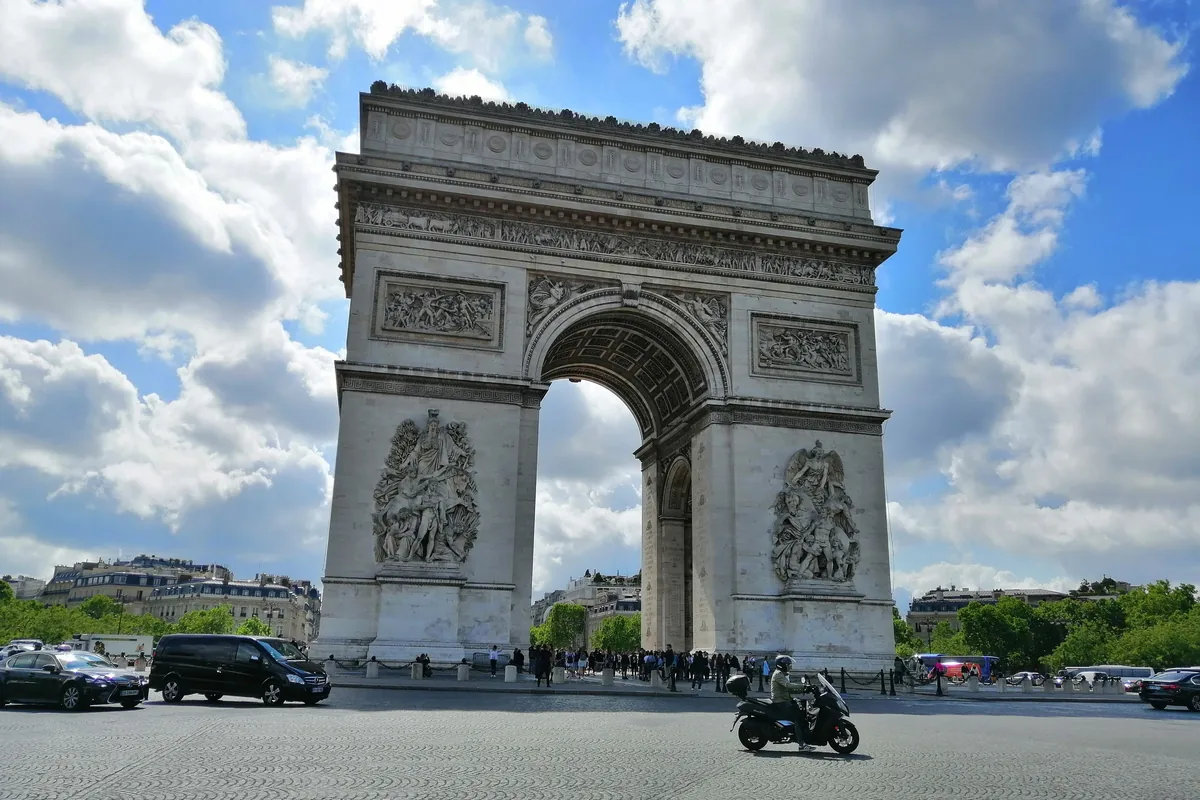
The Arc de Triomphe at Sunset and Blue Hour
How to time the climb for golden hour, the 18:30 eternal-flame ceremony, the twice-yearly sun alignment down the Champs-Élysées, and the hourly Eiffel Tower sparkle visible from the 49.54-metre terrace.
The 49.54-metre terrace of the Arc de Triomphe is unusual among Paris viewpoints: it sits on the axis that defines half the city. Looking east you have the Champs-Élysées, the Tuileries, the Louvre and (on clear evenings) the Bois de Vincennes. Looking west you have the long open boulevard of the Avenue de la Grande-Armée, the Pont de Neuilly, La Défense and the Grande Arche. The sun sets along this axis twice a year, and the Eiffel Tower — clearly visible to the south — sparkles for five minutes every hour from nightfall. This guide explains how to plan a sunset climb so you catch the light, the ceremony beneath the vault, and the first hourly sparkle from above, without arriving so late that you're queueing in the dark.
Why the terrace is unusually well-placed for sunset
The Arc sits at the meeting point of twelve avenues at the Place Charles de Gaulle (formerly Place de l'Étoile), and two of those avenues — the Champs-Élysées eastward and the Avenue de la Grande-Armée westward — lie on a single straight line that continues, in both directions, for kilometres. This is the historic axis of Paris, sometimes called the Voie Triomphale. From the terrace you stand directly on the axis at a height that puts the sun, the Louvre Pyramid and the Grande Arche of La Défense all in a single backwards-and-forwards sightline. No other public viewpoint in central Paris gives you that geometry.
Practically this means the terrace is good for sunset in two distinct ways. Looking west, the sun drops over La Défense and lights the Avenue de la Grande-Armée; this is the view most photographers come for. Looking east, the last sun of the day rakes the Champs-Élysées at an angle low enough to throw long shadows down the avenue's length, lighting the chestnut trees and the Hôtel de Crillon at the Place de la Concorde. The Eiffel Tower sits roughly south-southwest, so it is lit by the same setting sun a few minutes before the sun crosses the western horizon.
Golden hour and blue hour timing
Golden hour at the Arc de Triomphe runs roughly from 60 minutes before sunset to sunset itself. In Paris that means a window starting around 19:30 in late May and June, around 18:30 in March and early October, and as early as 15:45 in mid-December. The terrace is fully exposed and there is no glass, so the warm light strikes both your subject and your sensor unfiltered. Aim to be on the terrace at least 30 minutes before sunset to find a position along the western parapet and let your eyes adjust to the contrast between the lit stonework and the darker east-facing avenues.
Blue hour — the 20 to 30 minutes after sunset, when the sky holds deep blue light but the city's lamps are already on — is the single best window for the Champs-Élysées eastward shot. The chains of street lamps along the avenue light up at civil twilight; the Louvre is just visible at the far end; and the sky retains enough colour to give a clean gradient above the buildings. This is also the window in which the Eiffel Tower starts to sparkle: the first sparkle of the evening fires on the first hour-mark after nightfall, so in summer that's 22:00 and in winter as early as 18:00.
The Eiffel Tower sparkle, hour by hour
Since 31 December 1999, when 20,000 flashing bulbs were installed for the millennium celebration, the Eiffel Tower has sparkled for five minutes on the hour, every hour, from nightfall until late evening. From the Arc de Triomphe terrace the tower sits roughly 2.1 kilometres south-southwest, low enough on the horizon that the sparkle reads as a clear cluster of white pinpricks against the bronze and gold of the tower's continuous lighting. The 2.1-kilometre distance is close enough to capture detail with a 70–200mm telephoto, and far enough that a wide lens still keeps the tower in pleasing scale with the city around it.
If you want to photograph the sparkle, plan around two specific hour-marks. The first sparkle after sunset gives you a still-blue sky behind the tower and the strongest balance between ambient light and the flash points — this is the shot that gets sold. The second sparkle, an hour later, gives you a black sky with city lights below, which is the more dramatic but less colour-rich frame. Both are five minutes long. The tower's continuous golden lighting also dims briefly around midnight (later in summer) before switching off; if you stay late, you can frame the moment the sparkle ends and the tower itself goes dark against the city.
The twice-yearly sun-down-the-axis phenomenon
Twice each year the setting sun aligns with the Voie Triomphale closely enough that, from the eastern end of the axis, the sun appears to drop directly through the central archway of the Arc de Triomphe. The phenomenon is informally called the Paris Stonehenge effect. The two annual windows fall roughly in the second week of May and again in the first half of August, when the sun's setting azimuth matches the axis's bearing of about 26 degrees north of west. Cloud cover decides each year's photographable evenings; clear skies in both windows are not guaranteed and the alignment shifts by a few minutes from one evening to the next.
From the Arc's terrace you cannot see this effect — you are inside the archway, not east of it. The classic vantage is from the Place de la Concorde, the Tuileries, or the upper terraces of the Louvre, looking west along the Champs-Élysées. Plan a sunset climb on a non-alignment evening if you want the view from the terrace itself, or stay at ground level on alignment evenings and shoot eastward back toward the Arc. The two activities are complementary and not interchangeable on the same evening: a terrace ticket booked for an alignment date means missing the alignment shot from below.
Practical: ceremony timing, camera gear, tripod permits
If you want both the sunset terrace and the 18:30 eternal-flame ceremony beneath the vault, book a timed entry roughly 90 minutes before sunset. That gives you 45 to 60 minutes on the terrace, time to descend by 18:15, ten minutes for the ceremony, and a clean exit before the closing wave. In June and July the timing splits: ceremony is at 18:30, sunset is around 21:45. You can do the ceremony first, leave the monument, eat dinner nearby, and return for blue hour from the surrounding streets — but you cannot re-enter the paid climb on the same ticket. In winter (October–March), the 18:30 ceremony falls after sunset, so reverse the order: climb first, descend for the ceremony, leave at closing.
Handheld photography is permitted everywhere on the monument. Tripods, monopods, gimbals and other professional equipment require a separate permit from the Centre des monuments nationaux, which manages the site. The permit is intended for commercial shoots and editorial work; casual visitors carrying small travel tripods are usually waved through if the tripod stays folded inside the museum level and only deploys briefly on the terrace, but staff have authority to refuse. If your shot depends on a long exposure — for example a 5- to 10-second blue-hour exposure to smooth car-light trails on the Champs-Élysées — apply for the permit in writing several weeks ahead. The CMN replies in French and asks for a description of the shoot's commercial use.
常见问题
What time does golden hour start at the Arc de Triomphe?
Roughly 60 minutes before sunset. In Paris that's around 19:30 in late May and June, around 18:30 in early October, and as early as 15:45 in mid-December. Arrive on the terrace at least 30 minutes ahead to position yourself along the western parapet.
When does the Eiffel Tower sparkle and for how long?
Every hour on the hour from nightfall, for five minutes each time. The tradition started on 31 December 1999 with 20,000 flashing bulbs installed for the millennium celebration. In summer the sparkles run until late evening; in winter the first sparkle can be as early as 18:00.
Can I see the Eiffel Tower sparkle from the Arc de Triomphe terrace?
Yes. The tower sits roughly 2.1 kilometres south-southwest and the sparkle reads clearly against its continuous golden lighting. A 70–200mm telephoto captures detail; a wide lens keeps the tower in scale with the surrounding cityscape.
What is the Paris Stonehenge sun alignment?
Twice each year — roughly the second week of May and the first half of August — the setting sun aligns with the Champs-Élysées axis and appears to drop through the central archway of the Arc de Triomphe when viewed from the east. The alignment shifts by a few minutes per evening.
Can I see the sun-axis alignment from the Arc's terrace?
No. From the terrace you are inside the archway, not east of it. The classic vantage is the Place de la Concorde, the Tuileries, or the upper Louvre terraces, looking west. A terrace ticket on an alignment evening means missing the alignment shot from below.
Do I need a tripod permit at the Arc de Triomphe?
Tripods, monopods and gimbals technically require a separate permit from the Centre des monuments nationaux. Small folded travel tripods are usually tolerated; large professional rigs are not. Apply in writing several weeks ahead if your shot depends on a stabilised long exposure.
How do I plan a sunset climb around the 18:30 ceremony?
Book a timed entry about 90 minutes before sunset in summer (giving you 45–60 minutes on the terrace, then a descent by 18:15 for the ceremony). In winter, when the ceremony falls after sunset, climb first and descend for the ceremony. You cannot re-enter on the same ticket.
What's the best lens for terrace photography?
A 24–70mm zoom covers most needs — the avenues spreading from the Place fit a wide frame, while a mid-tele isolates the Eiffel Tower or La Défense. A 70–200mm captures the Eiffel sparkle in detail. Anything longer is hard to handhold in wind on an exposed terrace at dusk.
Is the terrace open in summer late enough for blue hour?
Last admission is set by the operator's published hours and shifts seasonally. In May, June and July the closing hour falls well after sunset, so blue hour on the terrace is possible. In winter the monument typically closes before full darkness, so the blue-hour shot must be taken from ground level after descent.
Can I shoot the eternal flame ceremony at 18:30?
Yes — without flash. The vault is dim and a fast lens helps. The ceremony is solemn; the bugle call and Marseillaise carry through the vault and the shutter sound of a mirrorless camera is far less disruptive than a DSLR mirror slap during the silence.