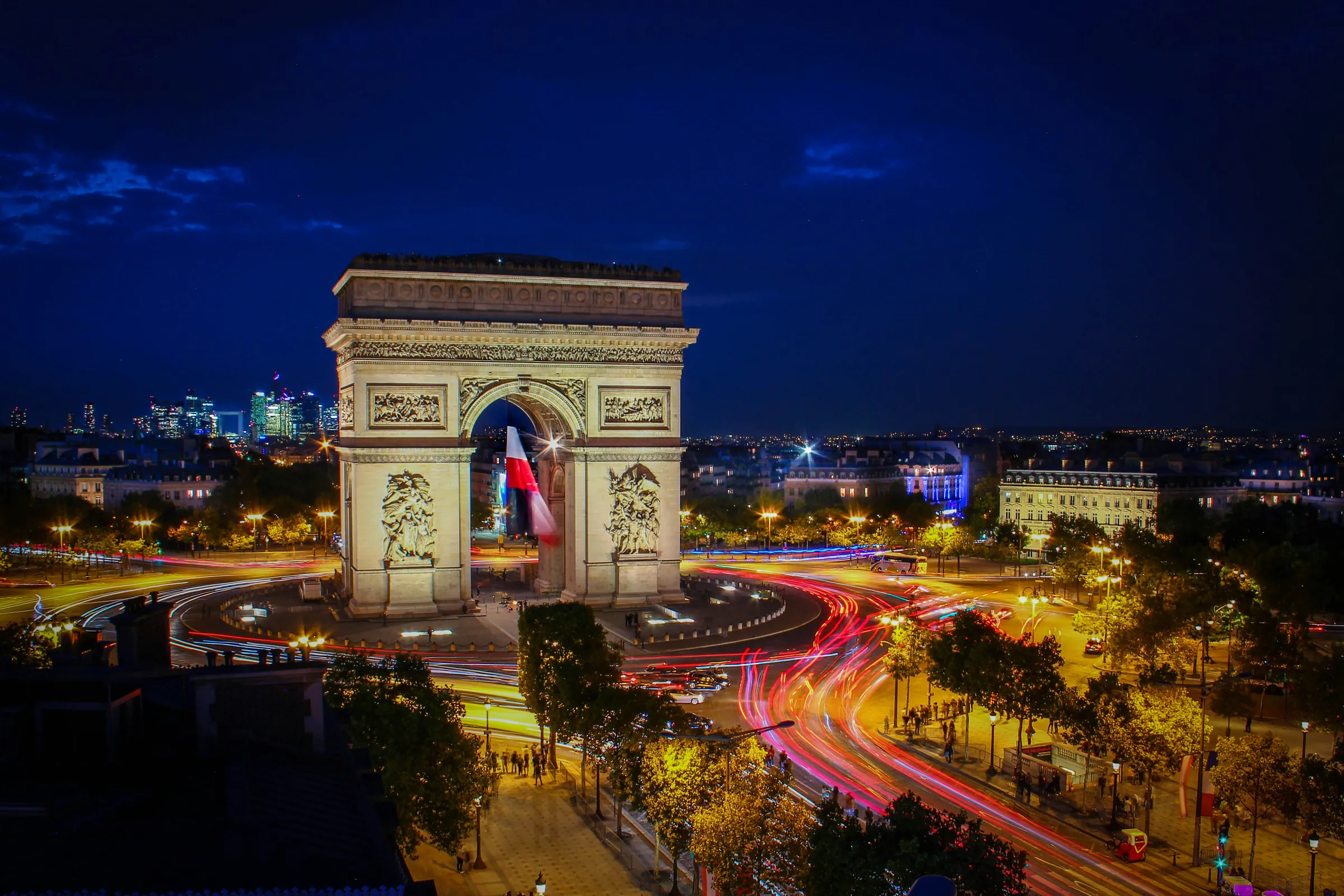
Arc de Triomphe vs Eiffel Tower vs Montparnasse
Three rooftop views, three very different visits — how to pick the right one for your trip
Three monuments dominate the choice of a Paris rooftop visit: the Arc de Triomphe at 50 metres, the Eiffel Tower at 276 metres, and the Montparnasse Tower at 210 metres. They are not interchangeable. Each gives a different city — different framing of the Eiffel Tower, different distance to the Seine, different relationship with crowds and timed-entry systems. Choosing well depends on what you want to photograph, how much queueing you will accept, and whether the view is the visit or a stop on a longer day.
Height, view, and where the Eiffel Tower sits
Pure height is the most-quoted statistic but rarely the one that matters. The Eiffel Tower's top floor sits at 276 metres above the Champ-de-Mars, the Montparnasse 56th-floor terrace at 210 metres, and the Arc rooftop at 50 metres above the Place Charles de Gaulle. The Eiffel and Montparnasse heights produce a view that resembles a satellite image: the Seine looks narrow, the boulevards look thin, and most landmark buildings are reduced to distant icons. The Arc is closer to a film-camera height — boulevards have real width, you can read individual cars on the Champs-Élysées, and the twelve-avenue Étoile pattern is clearly legible directly below. Which of these is 'best' depends entirely on whether you want intimacy or scale.
The decisive question for most photographers is where the Eiffel Tower sits in the frame. From the Arc rooftop the Tower is roughly 1.6 kilometres to the south-west and fills a satisfying portion of the horizon — large enough to recognise individually, small enough to compose with surrounding Haussmannian rooftops. From the Montparnasse terrace the Tower is roughly 2 kilometres to the north-west and is the unambiguous centrepiece of the view. From the Eiffel Tower itself, the Tower is obviously absent. This single point — Tower-in-frame — is why many visitors who only have time for one viewpoint and who want a photograph of the Tower choose either the Arc or Montparnasse rather than the Eiffel itself.
Crowds, queues, and timed-entry
The Eiffel Tower handles roughly seven million visitors a year and operates a tightly controlled timed-entry system. Even with a pre-booked ticket, expect 30–60 minutes of queue at the lifts in peak season, and considerably longer at the security check on busy summer evenings. Montparnasse Tower receives a fraction of that volume — perhaps 700,000 visitors a year — and uses a lighter timed-entry system; entry is normally within 10 minutes of arrival, lift time included. The Arc de Triomphe sits roughly in the middle at around 1.7 million visitors a year, operates timed-entry, and on a midweek morning a pre-booked ticket usually gets you onto the staircase within five minutes.
Practical implication: the Arc and Montparnasse are forgiving of imperfect timing and tolerate a same-day decision. The Eiffel Tower punishes both. The Eiffel Tower's queue dynamic also affects how the visit feels at the top — the lift system shuffles large numbers of people through the second floor and the summit in waves, and the platforms can feel crowded even when the building is operating normally. The Arc rooftop, by contrast, rarely feels crowded; the spiral staircase acts as a natural throttle on the rate of arrival. Montparnasse is the quietest of the three at typical times, particularly outside the sunset window.
Best for sunset, best for daylight, best for blue hour
Sunset is the most-photographed moment at all three sites and has a clear hierarchy. The Eiffel Tower's summit faces every direction and gives a unique top-of-the-city sunset, but the Tower itself is missing from your photographs. The Arc rooftop has the most cinematic sunset because the western view runs straight down the Avenue de la Grande-Armée toward the modern arch at La Défense, and the setting sun aligns with that axis on multiple days each year — the dates vary, but late February and mid-October are the headline windows. Montparnasse gives the most balanced sunset because the western view holds the Tower in profile against the colour change.
Daytime visits favour the Arc and Montparnasse. Blue-sky photographs from the Eiffel Tower can be impressive but tend to flatten because of the height; the Arc and Montparnasse give better readable detail in midday light. Blue hour — the 30 minutes after sunset when the sky is still bright but the city lights are on — is where the Tower-in-frame question becomes decisive. The Eiffel Tower itself begins its hourly sparkle on the hour, every hour, from sunset to 23:00 (or 01:00 in summer), and the five-minute sparkle is the headline shot from the Arc and Montparnasse rooftops. Both sites permit tripods; the Eiffel Tower restricts them in practice.
Accessibility and the climb question
Accessibility is where the three monuments diverge most sharply. The Eiffel Tower has lifts to the second floor and to the summit; all main viewing platforms are wheelchair-accessible. Montparnasse has lifts to the 56th-floor enclosed observatory and the 59th-floor open-air terrace; both levels are wheelchair-accessible. The Arc de Triomphe has 284 spiral steps and the only lift goes to the museum mezzanine, not the rooftop, and is restricted to specific eligibility categories. Visitors who cannot climb 50 steps can reach the Arc museum level but not the rooftop terrace.
For families with young children, the Eiffel Tower is the easiest in operational terms but the most exhausting in queue terms. Montparnasse is the easiest overall — short queues, full lift access, an enclosed viewing floor with seating, and an open terrace one floor above. The Arc is the most physical but also the most rewarding for older children who can manage the climb; the 284-step staircase is a memorable experience in its own right, and the museum level breaks the ascent. Strollers are barred at the Arc and not advised on the Eiffel Tower; Montparnasse accepts them throughout.
Combining the three — and which to skip
Visitors with two days for view-points typically combine the Arc and the Eiffel Tower, sometimes adding Montparnasse for a sunset photograph. The optimal sequencing is: Arc in the morning (low queues, eastern light along the Champs-Élysées, museum visit included), Eiffel Tower in the late afternoon (allowing for the queue and reaching the summit before sunset), Montparnasse for blue hour and the Eiffel Tower sparkle. The reverse order is also workable — Montparnasse early for daytime city orientation, Arc at sunset, Eiffel Tower the next morning when queues are lightest.
If you have time for only one, the answer depends on the photograph you want to take home. Want the Eiffel Tower in the frame? Choose the Arc or Montparnasse. Want to stand on top of the Eiffel Tower? Choose the Tower itself and accept the queueing. Travelling with mobility constraints? Montparnasse offers the easiest experience at any time of day. Travelling with school-age children who want a story to tell? The Arc and its 284-step climb is the most memorable of the three. The default 'visit all three' itinerary is rarely necessary and often produces three diluted visits where one focused visit would have been more rewarding.
常見問題
Which Paris view is the best for photographs of the Eiffel Tower?
Either the Arc de Triomphe (1.6 km away, intimate framing) or Montparnasse Tower (2 km away, dominant centrepiece). Both give the Tower in the frame, which the Eiffel Tower itself cannot.
Is the Arc de Triomphe view worth the climb?
Yes, for most visitors. The 284-step climb is part of the experience, and the rooftop view gives the only true 360-degree central-Paris panorama at film-camera height — boulevards have width, the Étoile pattern is legible below, and the Champs-Élysées axis runs to the Louvre on one side and La Défense on the other.
How long is the queue at the Eiffel Tower?
With a pre-booked ticket, expect 30–60 minutes at the lifts in peak season. Walk-up tickets routinely queue 1.5–2 hours. The Arc and Montparnasse queues are usually under 15 minutes for pre-booked visitors.
Which is best for sunset?
The Arc de Triomphe rooftop in late February or mid-October when the sun sets along the Champs-Élysées–Grande-Armée axis. Montparnasse gives the most balanced sunset year-round because it holds the Tower in profile. The Eiffel Tower itself gives a unique sunset view but the Tower is missing from photographs.
Can wheelchair users visit the Arc de Triomphe rooftop?
No. The lift only reaches the museum mezzanine and the final 50 steps to the rooftop cannot be bypassed. Wheelchair users seeking a rooftop view of Paris should choose Montparnasse Tower (fully lift-accessible) or the Eiffel Tower (lifts to all main floors).
How tall is each monument?
Eiffel Tower 276 m (top floor); Montparnasse Tower 210 m (56th floor terrace); Arc de Triomphe 50 m (rooftop terrace).
What is the Eiffel Tower sparkle?
A five-minute light show that runs at the top of each hour after sunset, until 23:00 (01:00 in summer). It is best photographed from a viewpoint that includes the Tower — typically the Arc rooftop, Montparnasse terrace, the Trocadéro, or the Champ-de-Mars.
Are strollers allowed at any of the three?
Montparnasse accepts strollers throughout. The Eiffel Tower allows them on the lifts but the platforms become crowded. The Arc de Triomphe bars them from the staircase and lift; there is a supervised pram parking area at the entrance.
Which has the shortest visit?
Montparnasse — typically 45 minutes including lift up and down. The Arc takes 60–75 minutes including the climb and museum. The Eiffel Tower with summit access usually consumes 2–3 hours.
Can I visit all three in one day?
It is possible but rarely advisable. The Eiffel Tower alone consumes a large block of time once queueing is included. Most visitors get a better experience choosing two and visiting them at complementary times — for example Arc morning, Montparnasse blue hour.